


1. Preparation
2. Bonding
3. Sealing
4. Covering
5. Details
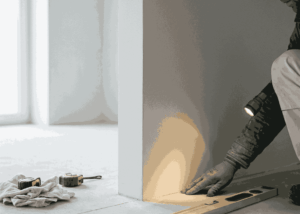
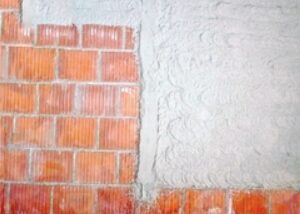 Remove any loose or flaking plaster, sand away dust, and check for residual moisture on the wall surface; repair cracks and irregularities beforehand, since an uneven substrate weakens adhesion and can create acoustic bridges once the wall is closed up.
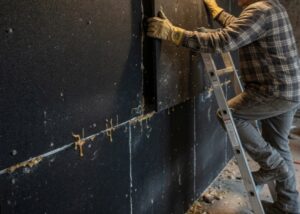 Apply polyurethane foam or a specific high-hold adhesive in spots or continuous beads across the back of the panel, then position it against the wall and press firmly along the whole surface to ensure uniform, air-tight contact with no gaps.
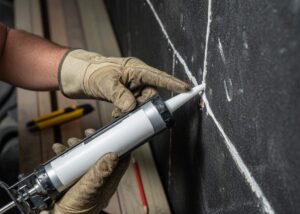 Seal every joint between adjacent panels and the full perimeter against floor, ceiling and adjoining walls with acoustic mastic, since even a small unsealed gap can significantly reduce the overall airborne sound insulation of the finished wall.
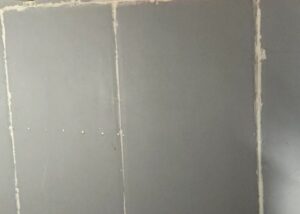 Apply two staggered layers of drywall over the MGEL panel, offsetting the joints between the two layers and carefully filling and sealing every seam, in order to maximize the overall mass and continuity of the finished partition wall.
Seal electrical outlets and switch boxes with acoustic putty pads, and check for flanking noise paths such as skirting boards, adjoining stud walls and service penetrations, since these are common weak points that let airborne noise bypass the panel.
1. Frame
2. Placement
3. Fixing and sealing
4. Finishing
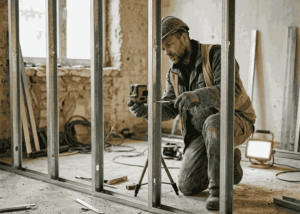 Set up a metal or wood stud frame with adequate spacing between uprights, sized according to the wall height and the loads it will support, making sure the structure is plumb and securely anchored before any panel is fitted to it.
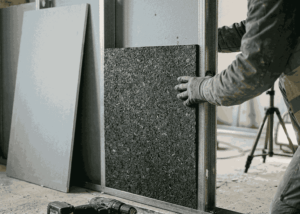 Fix the first drywall board to one side of the frame, bond the MGEL panel directly onto it or onto the studs, then complete the assembly with a second drywall board on the same side, staggering its joints against the first layer.
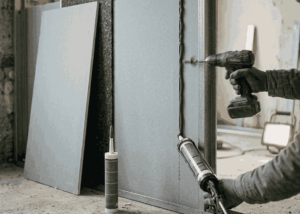 Fix all boards with screws that comply with the frame type and board thickness, then seal the full perimeter and every joint between panels with acoustic mastic, since unsealed edges create direct paths for airborne noise to pass through.
 Apply the chosen surface finish once the boards are fixed, and carefully check that the acoustic sealing is continuous along the entire perimeter of the wall, with no gaps left at corners, floor, ceiling or adjoining structures.