

Certified Impact Sound Insulation for Screed and Underfloor

Certified Impact Sound Insulation for Screed and Underfloor
Laboratory Tests on Rubber and Cork-Rubber Acoustic Mats
A certified impact sound insulation is a flooring material designed to reduce footfall noise and structural vibrations, with acoustic performance measured in laboratories according to international standards such as ISO 10140-3, ISO 717-2, and EN 29052-1.
Certification allows the use of objective data in design calculations for residential and commercial buildings.
We are pleased to announce the start of accredited laboratory tests on our impact sound mats made of rubber and cork-rubber, designed for applications under screed and underfloor.
The goal is to obtain official acoustic certification for 3 mm and 5 mm thicknesses, both in pure rubber and rubber-cork combination, according to international building acoustics standards.
Testing Standards and Certification Objectives
Laboratory tests are performed according to the following standards:
- ISO 10140-3 – Measurement of impact sound insulation
- ISO 717-2 – Assessment of acoustic insulation
- EN 29052-1 – Determination of dynamic stiffness
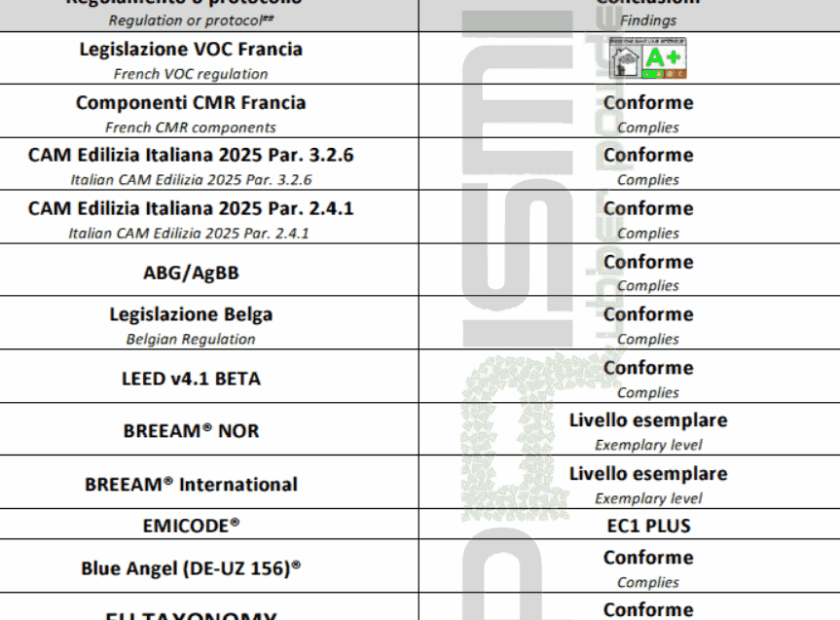
For the 3 mm cork-rubber material, VOC testing is also conducted, mandatory for the French market, according to:
- UNI EN ISO 16000-9:2024
- ISO 16000-3:2022
This phase is essential because it transforms a technical product into a certified impact sound insulation, offering real value to designers, installers, resellers, and end customers.
Why Certify a Screed and Underfloor Acoustic Mat
Acoustic certification provides a measurable and verifiable assessment of product performance and ensures compliance with building acoustics regulations.
The tests evaluate:
- Footfall noise insulation for 3 mm and 5 mm thicknesses
- In-situ behavior as a screed mat or underfloor mat
- Consistency of acoustic performance across production samples
Results allow us to confirm the product’s suitability for new buildings, renovations, and floating floors.
Technical Features of the Impact Sound Mat
Our insulation rolls offer:
- Materials: natural/synthetic rubber and cork-rubber
- Certified thicknesses: 3 mm and 5 mm
- Applications: under screed, under floating floors
- Key benefits:
- noticeable reduction of footfall noise
- improved acoustic comfort
- compatibility with glued and floating installation
Practical Advantages on Site
- easy and quick installation
- high wear resistance and long-term dimensional stability
- sustainable solution in the cork combination version
Shipment of Samples to Accredited Laboratory
For testing, pallets with samples were prepared for each type and thickness.
Photographic documentation of shipment demonstrates transparency and the care taken in preparing materials for testing.
Included Test Methods
- Impact sound insulation according to ISO 10140-3 and ISO 717-2
- Dynamic stiffness testing according to EN 29052-1
- VOC emission testing according to EN 16516 and ISO 16000
Test results will be shared with clients to support footfall noise reduction calculations for floors and screeds.
Technical FAQ on Certified Impact Sound Insulation
When is impact sound insulation certification necessary?
Certification is required when acoustic values must be used in design calculations or to demonstrate compliance with building acoustic regulations.
Can an uncertified mat be used in acoustic calculations?
No. Only materials tested in a laboratory according to recognized standards provide valid acoustic data suitable for design purposes.
What is the difference between dynamic stiffness and impact sound reduction?
Dynamic stiffness measures the elastic behavior of the material, while impact sound reduction indicates the actual decrease in footfall noise. Both parameters are complementary.
Why is VOC testing important?
VOC testing verifies emissions of volatile organic compounds and is mandatory for marketing materials in certain countries, such as France.