Prismi srl Logo organization
  • ACCUEIL
  • SERVICE
  • Production rouleaux en caoutchouc
    • ROULEAUX EN CAOUTCHOUC ACOUSTIQUE
    • ROULEAUX EN CAOUTCHOUC LIÈGE ACOUSTIQUE
    • Bande acoustique en caoutchouc MGEF
    • Plaque en caoutchouc isolation cloisons
  • NOUVELLES
    • VIDEO
  • CONTACT
    • Privacy Policy
  • Français
    • Anglais
    • Italien
    • Espagnol
    • Allemand

Tapez pour rechercher

Prismi srl Logo organization
  • ACCUEIL
  • SERVICE
  • Production rouleaux en caoutchouc
    • ROULEAUX EN CAOUTCHOUC ACOUSTIQUE
    • ROULEAUX EN CAOUTCHOUC LIÈGE ACOUSTIQUE
    • Bande acoustique en caoutchouc MGEF
    • Plaque en caoutchouc isolation cloisons
  • NOUVELLES
    • VIDEO
  • CONTACT
    • Privacy Policy
  • Français
    • Anglais
    • Italien
    • Espagnol
    • Allemand
  • ACCUEIL
  • SERVICE
  • Production rouleaux en caoutchouc
    • ROULEAUX EN CAOUTCHOUC ACOUSTIQUE
    • ROULEAUX EN CAOUTCHOUC LIÈGE ACOUSTIQUE
    • Bande acoustique en caoutchouc MGEF
    • Plaque en caoutchouc isolation cloisons
  • NOUVELLES
    • VIDEO
  • CONTACT
    • Privacy Policy
  • Français
    • Anglais
    • Italien
    • Espagnol
    • Allemand
Prismi srl Logo organization

Tapez pour rechercher

  • Français
    • English
    • Italiano
    • Español
    • Deutsch
Prismi srl Logo organization
  • ACCUEIL
  • SERVICE
  • Production rouleaux en caoutchouc
    • ROULEAUX EN CAOUTCHOUC ACOUSTIQUE
    • ROULEAUX EN CAOUTCHOUC LIÈGE ACOUSTIQUE
    • Bande acoustique en caoutchouc MGEF
    • Plaque en caoutchouc isolation cloisons
  • NOUVELLES
    • VIDEO
  • CONTACT
    • Privacy Policy
  • Français
    • Anglais
    • Italien
    • Espagnol
    • Allemand
rouleaux caoutchouc acoustique

Rubber Soundproofing Sheets & Rolls: The Complete B2B Guide
Rubber Soundproofing Sheets & Rolls: The Complete B2B Guide

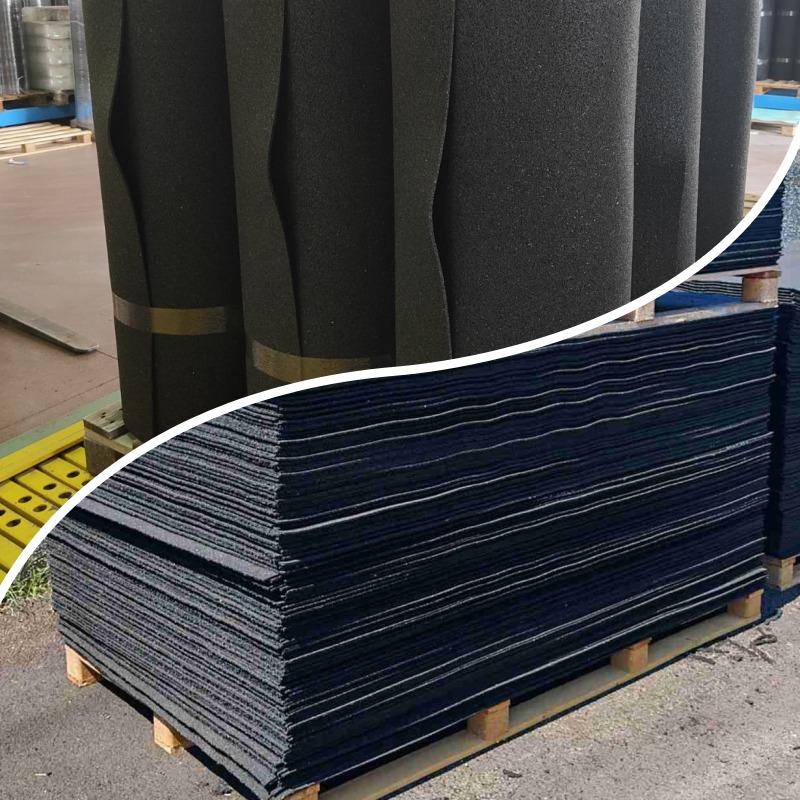
Recycled rubber sheets and rolls are the industry standard for combining mass, durability and circular-economy sourcing in sound deadening applications. This guide explains how density, thickness and roll format determine performance, and which Prismi product line fits each use case.

What Are Rubber Soundproofing Sheets and Why They Work

Rubber sound deadening sheets reduce noise transmission through mass and internal damping rather than absorption. Unlike foam or fiber materials, which trap airborne sound waves inside a porous structure, a rubber sound damping sheet adds density to a surface, limiting the amount of vibrational energy that passes through it. This is why sound proof sheet products made from recycled vulcanized rubber consistently outperform lighter materials of the same thickness in impact and airborne noise reduction. In flooring, roofing, automotive and industrial settings, soundproofing rubber is chosen specifically because it delivers this mass-based damping in a compact, rollable format that is easy to cut and install.

Sheet vs Roll: Choosing the Right Format

A soundproofing sheet is typically supplied in fixed panel dimensions, ideal for small, defined surfaces or sample testing. Rubber flooring rolls, by contrast, are manufactured in continuous lengths and are the preferred format for large-scale industrial and commercial installations, gyms, factory floors, subfloor underlayment, because they minimize seams and reduce installation time. Rubber roll flooring also allows for standardized thickness control across long runs, which matters when a project specification requires consistent acoustic performance batch to batch.

Density and Thickness: Reading a Technical Data Sheet

When comparing a sound deadening rubber product, two figures matter more than any marketing claim: density (kg/m³) and thickness (mm). Higher density at the same thickness generally improves airborne noise reduction, while thickness alone affects impact noise absorption differently depending on the substrate. Buyers sourcing rubber sound proofing in bulk should always request density and thickness tolerances in writing, since batch-to-batch consistency is what allows architects and acoustic consultants to reliably specify a product in technical drawings.

Where to Use Rubber Sheets and Rolls

Typical applications include subfloor underlayment beneath resilient or hardwood flooring, gym and industrial flooring, machinery isolation pads, and as a damping layer within composite wall or floor assemblies. Prismi’s acoustic rubber rolls are supplied in bulk for B2B buyers, distributors, flooring installers and manufacturers, who need consistent recycled rubber material for their own product lines.

Recycled Rubber and Circular Economy Sourcing

Most rubber sound deadening sheets and rolls on the market today are manufactured from recycled vulcanized rubber, typically reclaimed from end-of-life tires. This matters for two reasons beyond sustainability positioning: recycled rubber compounds tend to offer excellent density and durability characteristics well suited to sound damping applications, and increasingly, public procurement tenders and corporate ESG requirements explicitly favor or require documented recycled content. A soundproofing rubber supplier able to provide traceability on recycled material sourcing gives B2B buyers a real competitive advantage when bidding on institutional or public-sector projects.

Common Buying Mistakes to Avoid

The most frequent sourcing mistake is comparing rubber sound proofing products on price per square meter without normalizing for density and thickness, a thin, low-density sheet will always look cheaper than a comparable high-performance one, but will underperform in the field. A second common mistake is failing to request batch consistency documentation, which becomes critical on large projects where visual and acoustic uniformity across a floor or wall matters. Buyers should also confirm whether technical data sheets report tested values for the finished assembly or only for the raw rubber material, since the two can differ significantly once installed. For a comparison of how this material behaves against alternatives, see our guide to the Soundproof Flooring Guide and the Acoustic Underlay Guide.

PrevFournisseur de matériaux acoustiques

Fournisseur de matériaux acoustiques

27 juin 2026

Sound Deadening Sheets vs Foam: What's the Real Difference

18 août 2026
NextSound Deadening Sheets vs Foam: What's the Real Difference

Related Posts

Read More
rouleaux caoutchouc acoustique
23 juillet 2025by think green

Gomme recyclée pour l’isolation acoustique : durabilité et performance sous le sol

Gomme recyclée pour l’isolation acoustique : durabilité et performance sous le...
Read More
rouleaux caoutchouc acoustique
22 décembre 2025by think green

Isolation acoustique certifiée pour chape et sous-plancher

Isolation acoustique certifiée pour chape et...
Recent Posts
  • How to Soundproof a Wooden Floor (Without Removing It)
  • Soundproof Flooring: The Complete Guide to Floor and Subfloor Noise Reduction
  • Rubber Roll Flooring: Buying in Bulk for Industrial and Commercial Projects
  • How Thick Should a Rubber Sound Deadening Sheet Be?
  • Sound Deadening Sheets vs Foam: What’s the Real Difference
Archives
  • août 2026
  • juin 2026
  • mars 2026
  • février 2026
  • décembre 2025
  • septembre 2025
  • août 2025
  • juillet 2025
  • juin 2025
Categories
  • rouleaux caoutchouc acoustique

Copyright © 1990-2026 Prismi - All Rights Reserved Prismi srl - via dell'industria 44 63076 Monteprandone (AP) Italy - P.IVA 01396170449

Top
Soundproof rubber rolls | Prismi
Manage Consent
To provide the best experiences, we use technologies like cookies to store and/or access device information. Consenting to these technologies will allow us to process data such as browsing behavior or unique IDs on this site. Not consenting or withdrawing consent, may adversely affect certain features and functions.
Functional Toujours activé
The technical storage or access is strictly necessary for the legitimate purpose of enabling the use of a specific service explicitly requested by the subscriber or user, or for the sole purpose of carrying out the transmission of a communication over an electronic communications network.
Preferences
The technical storage or access is necessary for the legitimate purpose of storing preferences that are not requested by the subscriber or user.
Statistics
The technical storage or access that is used exclusively for statistical purposes. The technical storage or access that is used exclusively for anonymous statistical purposes. Without a subpoena, voluntary compliance on the part of your Internet Service Provider, or additional records from a third party, information stored or retrieved for this purpose alone cannot usually be used to identify you.
Marketing
The technical storage or access is required to create user profiles to send advertising, or to track the user on a website or across several websites for similar marketing purposes.
  • Gérer les options
  • Gérer les services
  • Gérer {vendor_count} fournisseurs
  • En savoir plus sur ces finalités
View preferences
  • {title}
  • {title}
  • {title}