

Partition Wall Soundproofing: A Guide to Materials and Methods
Partition Wall Soundproofing: A Guide to Materials and Methods
Before choosing a specific product, it helps to understand what actually makes a partition wall block noise. This guide covers the material science and installation logic behind airborne noise reduction, with MGEL as the applied example.
Soundproof Wall Panels: Mass, Not Absorption
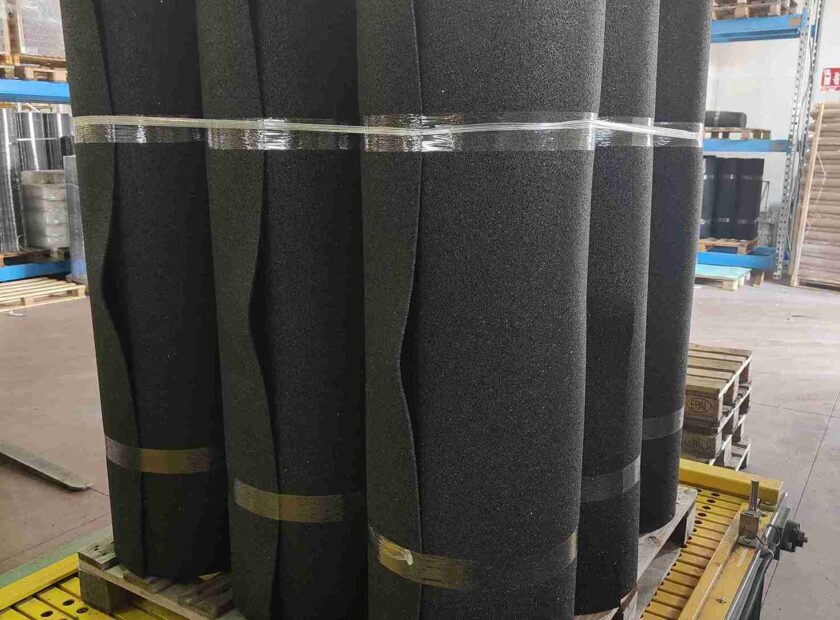
Soundproof wall panels built from high-density rubber work through the mass law of acoustics: adding weight to a wall assembly reduces how much airborne sound, voices, music, traffic, passes through it.
This is a fundamentally different mechanism from acoustic foam or fabric-wrapped absorptive panels, which manage reverberation inside a room but do very little to stop noise from reaching the next space. MGEL, at 700 kg/m³, is engineered specifically for this mass-driven role within a partition wall assembly.
Two Formats for Two Installation Methods
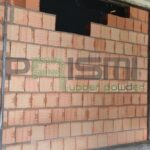
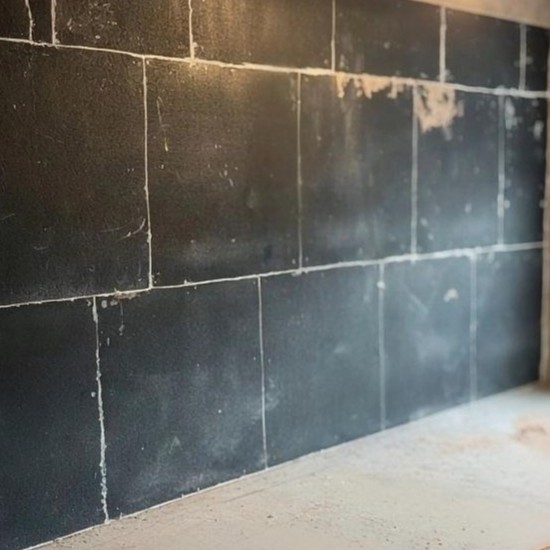
MGEL is produced in two formats: 1.00 × 1.20 m for direct manual bonding onto existing masonry, ideal for fast retrofit work by installers.
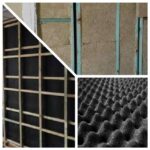
1.20 × 2.00 m for stud-framed double-wall systems, designed for professional job sites and panel manufacturers integrating the material into prefabricated assemblies. Both are available in 15 mm and 20 mm thickness.
Built for B2B: Distributors and Panel Manufacturers
Unlike decorative acoustic wall panels sold directly to end consumers, MGEL is supplied in bulk to distributors, acoustic specialists and manufacturers of acoustic drywall panels, including under private label.
Consistent density and thickness batch to batch is what allows these buyers to reproduce documented technical specifications across projects and product lines.
Laboratory Testing Underway
A double-wall system (8 cm + 12 cm) with an interposed MGEL panel is currently being tested at an ACCREDIA-accredited laboratory for Rw determination under ISO 10140 / ISO 717-1.
Results expected in September 2026, providing an official, third-party benchmark for the system’s airborne noise reduction performance.
Installation Overview: Two Methods, One Material
MGEL supports two distinct installation approaches to match different project types. Direct bonding of the 100×120 format onto existing masonry, using polyurethane foam or a high-hold adhesive, is suited to retrofit projects where speed and minimal disruption matter, the panel is sealed at every joint and perimeter with acoustic mastic, then covered with two staggered layers of drywall.
The 120×200 format, interposed within a stud-framed double-wall system, suits new-build and professional installations where the frame is built first, boards fixed progressively, and every seam sealed before finishing.
Both methods share the same core principle: continuous, gap-free contact and thorough perimeter sealing, since even small unsealed gaps significantly undermine the finished assembly’s airborne noise reduction.
Circular Economy Positioning for Public Procurement
As a recycled vulcanized rubber product, MGEL aligns with circular-economy sourcing criteria increasingly written into public procurement specifications across construction, renovation and infrastructure tenders in English-speaking markets.
Distributors and manufacturers bidding on public-sector projects can use MGEL’s recycled material composition as a documented sustainability credential alongside its acoustic performance data, a combination that’s becoming a genuine differentiator in competitive tender processes.
Worth a look too: MGEL product page, Rubber Soundproofing Sheets & Rolls, Soundproof Flooring Guide and Rubber Wall Break Strip MGEF product page.