

How Rw/STC Ratings Work for Partition Wall Systems
How Rw/STC Ratings Work for Partition Wall Systems
A single number often decides whether a wall assembly meets a building code or a client’s expectations. Here’s what that number actually measures.
What Rw and STC Measure
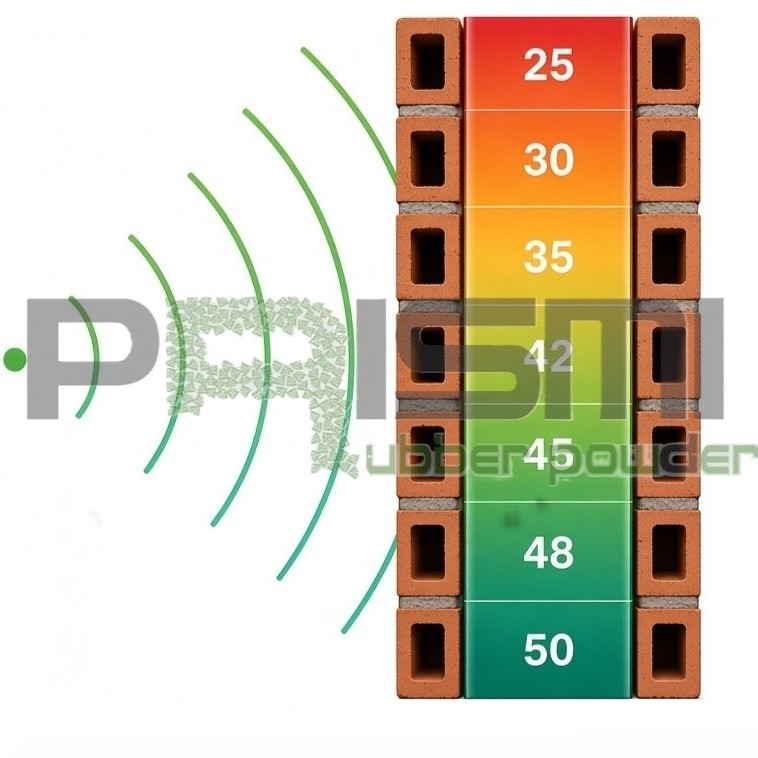
Rw (weighted sound reduction index, used in Europe under ISO 717-1) and STC (Sound Transmission Class, used in North America) both quantify how much airborne noise a wall assembly blocks across a range of frequencies.
Higher numbers mean better sound insulation, a wall rated Rw 55 blocks substantially more noise than one rated Rw 40.
How the Rating Is Determined
Ratings come from standardized laboratory testing (ISO 10140 internationally,
ASTM E90 in North America), where a complete wall assembly, not just a single material, is tested under controlled conditions.
This is why sound insulation panels for walls should always be evaluated as part of a full system rating, not based on the acoustic properties of one component in isolation.
Why System Testing Matters More Than Material Claims
A manufacturer’s claim about a single panel’s density or thickness cannot substitute for a full system Rw/STC test, because flanking paths, joint sealing and the surrounding assembly (drywall layers, stud spacing, sealants) all significantly affect the final result.
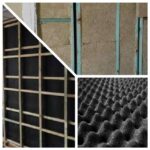
Prismi’s MGEL double-wall system (8 cm + 12 cm) is currently undergoing ACCREDIA-accredited testing under ISO 10140 / ISO 717-1, with results expected September 2026, to provide exactly this kind of system-level benchmark.
Using Ratings in Specification
Architects and contractors should specify a target Rw or STC value based on the project’s use case (residential separation walls typically require Rw 50+, higher for sensitive uses like recording studios or healthcare).
Select a tested wall assembly known to meet or exceed that figure, rather than assembling components based on individual material data sheets alone.
Common Misunderstandings About These Ratings
A frequent misunderstanding is treating Rw and STC as if they were interchangeable or directly convertible one-to-one, while the two scales are similar in concept.
They use different reference curves and are not perfectly equivalent, so a wall rated STC 50 in a North American test report should not be assumed identical to Rw 50 from a European test.
Another common error is applying a laboratory-tested rating directly to a real-world installation without accounting for flanking transmission, noise that travels around a wall through floors, ceilings or shared ductwork rather than through the wall itself, which can significantly reduce the actual in-situ performance compared to the lab-rated figure.
Worth a look too: Rubber Panels for Partition Walls hub and MGEL product page.